Spelunky is a cruel, ruthless game. I wasn’t able to beat it, so I suppose it got the best of me. Despite this, I’ve formed some neat theories about game design and player retention while dying over and over again.
I came into this game with a dilemma: should I make a roguelike, or a roguelite? I was finishing up the development of Void Wizard, which is a roguelike, not a roguelite. Most people didn’t play the game for very long, and I was afraid it was because it wasn’t a roguelite. Most modern roguelikes are actually roguelites. This seems to be because it’s easier to hold someone’s attention with roguelites, which keep you hooked by rewarding you when you die. I quite like this design choice, but the downside is that each individual run doesn’t feel as intense because the next run will be easier. You can just keep grinding until the game is too easy! (sometimes, anyway) This is of course due to the upgrades you get when you die. Despite not having permanent upgrades, I played a lot of Spelunky. This is my total playtime:

As you can see, it held my attention quite well. (Also, I somehow only have five achievements, which is probably pretty pathetic.) So, how does Spelunky do it? Well… I lied to you. It actually DOES have permanent upgrades! (…sorta)
In Spelunky you can unlock shortcuts, but that’s not what I’m talking about. I’m actually referring to knowledge.

You can discover new strategies and secrets, sure, but the real upgrades are the things you learn not to do. To me, this was actually almost as rewarding as uncovering a secret, for example. There are so many things that can kill you if you don’t know exactly how they work. What’s worse, there are chain reactions that can quickly devolve into chaos! For example, you could be hanging from a ledge, drop a rock you were carrying, trigger a dart trap with the rock, and hurt a shopkeeper with the dart trap, angering him. The shopkeepers are no joke, and an angry one will probably kill you.
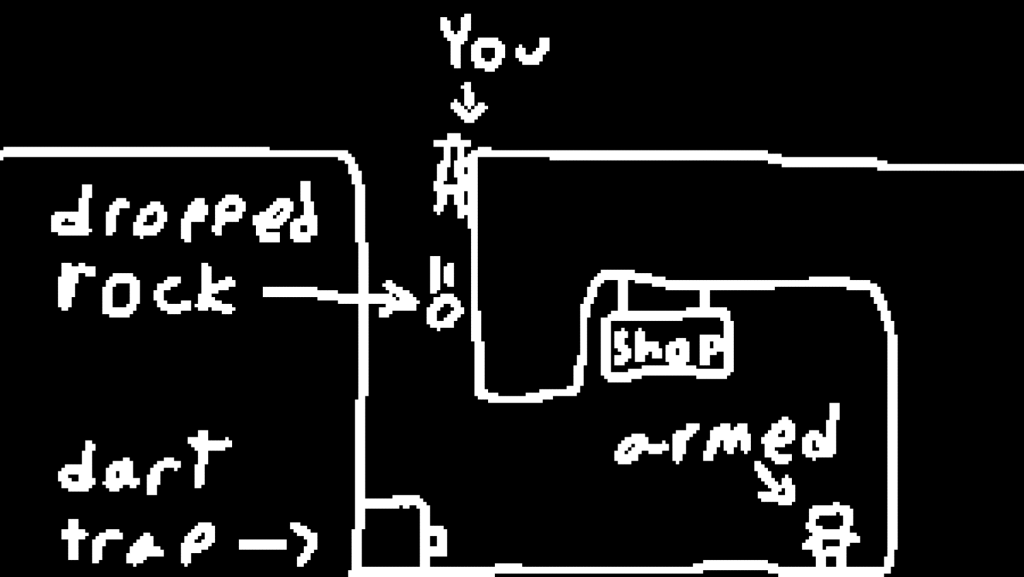
^^^^ an unfortunate situation! ^^^^
This is a good transition into talking about emergent gameplay. Spelunky has many different kinds of game objects which can all interact with each other in different and surprising ways. This is a genius way to create lots of content. For example, if you have five things that can interact and influence each other, that’s twenty five different interactions! (assuming an interaction consists of only two things.) Discovering these interactions was another thing that kept me coming back: I was simply curious to see what might happen in the next run, regardless if it helped me or not. These interactions can also generate mini narratives. For example, I found a shop that sells workers, aka hired hands. This was my first time seeing this shop, and curious to see what those guys could do, I bought one. I formed a very quick bond with him, but then, only five seconds later, he jumped off a cliff and died instantly.
Keeping with the theme of death, I died. A lot. I’d even sometimes die a few SECONDS into a run! So, how’d Spelunky keep me from quitting in frustration? (Again, I didn’t actually beat the game, but I played for over sixty hours, which is pretty good.) I think it was a combination of getting excited when I’d learn something, curiosity, and also the challenge. I almost saw Spelunky as an entity challenging me to a fight, and I didn’t want to back down. (I did eventually tho, but just forget about that part…)
Anyways, thanks for reading my ramblings. I hope you make some great games and stuff.
-Vincent Poteet
Founder of Antique Gear Games and creator of Void Wizard

 Antique Gear Games
Leave a comment